
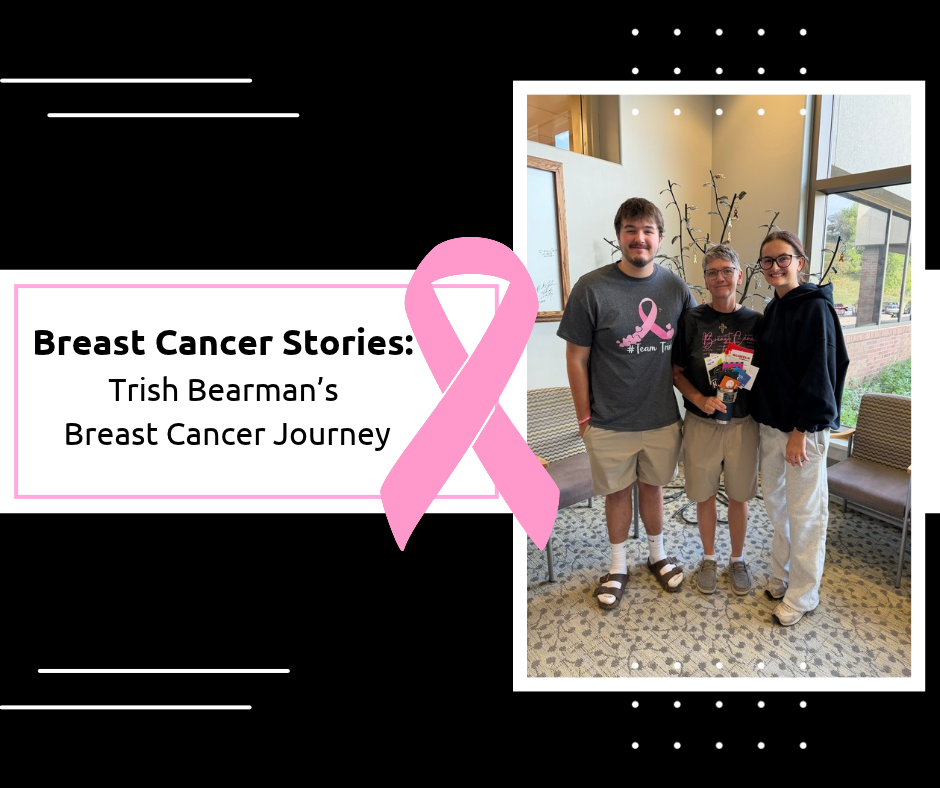
Breast Cancer Stories: Trish Bearman’s Breast Cancer Journey
Getting a yearly mammogram can significantly improve your chances of catching breast cancer early — and surviving it. In fact, according to the American Cancer Society, when breast cancer is detected early and is localized to the breast, the 5-year relative survival rate is more than 99%!
Breast cancer is the most common cancer in US women after skin cancer — it accounts for about 1 out of every 3 new cancer diagnoses in women each year. In fact, you probably know someone who has been diagnosed with breast cancer.
In the MCHC community, we have Trish Bearman. Trish is an ultrasound tech at MCHC who recently went through treatment for breast cancer. We asked Trish to share her story with you, in the hopes of encouraging more women to get regular mammograms.
Here’s Trish’s story, in her own words.
October 2025: My Yearly Mammogram
My breast cancer journey began when I went in for what I thought was a routine mammogram. When the report came back, I was told that I needed to return for a spot-compression mammogram and an ultrasound. The ultrasound showed a slightly suspicious area, but it wasn’t convincing enough for me to feel comfortable moving forward with a biopsy at that time, even though one was suggested.
Because I am an ultrasound technologist myself, I understood what they were seeing and what the possibilities were. After discussing my options, I decided to take the six-month follow-up approach and have the area monitored.
April 2026: The Diagnosis
In April, I returned for my follow-up mammogram and ultrasound. Unfortunately, the suspicious area was still there, and this time it appeared a little more obvious.
Being an ultrasound technologist myself made the experience surreal. I was used to being the person performing the ultrasound and helping patients through their fears. Now, I was the patient. It was difficult having to sit on the other side of the machine and put my trust in someone else’s skills and judgment.
Luckily, I was able to get in for an ultrasound-guided breast biopsy the very next day. A couple of days later, I received the results. I had invasive lobular carcinoma. Hearing those words was like getting punched in the gut.
Suddenly, everything changed.
The next step was a breast MRI, followed by an appointment with my general oncologist, Dr. Ibrahim, at CancerCare in Minot. Genetic testing was also recommended to determine whether there was a hereditary component to my cancer.
The breast MRI found another suspicious mass in the same breast, so I needed another biopsy — this time an MRI-guided biopsy.
Waiting for the results of that second biopsy was stressful, but thankfully, the mass was not cancerous at that time. However, I was told that it was a type of abnormality that would eventually develop into a completely different type of breast cancer.
Biopsy markers were placed during both the ultrasound-guided and MRI-guided biopsies so that the areas could be identified later. The next step was meeting with a surgeon.
Luckily, I have a close friend who is a nurse practitioner, and she told me something I didn’t know: North Dakota has a surgeon who specializes specifically in breast surgery. Nothing against the general surgeons at Trinity, but knowing there was an actual breast surgeon — someone who specializes in this particular type of cancer and surgery — made me want to seek out that level of expertise.
An appointment was made with Dr. Diane Ellis at the Sanford Roger Maris Cancer Center in Fargo. My nurse navigator at Sanford then called and told me that they wanted me to have another breast MRI, this time performed at their facility. After that, I met with Dr. Ellis.
The next decision was surgery. My options were a double lumpectomy or a mastectomy. Since my genetic testing came back negative, I ultimately chose to have the double lumpectomy.
The Day Before Surgery
Neither of the tumors could be felt by touch, so the radiologist needed to precisely mark their locations so that my surgeon would know exactly where to operate. They used mammography to guide a tiny magnetic marker, called a seed, directly into the tumor.
I have to say, this procedure was much more unpleasant than either of my biopsies. I had to sit in a chair while the mammography machine compressed my breast. Lidocaine was administered in the area where the marker was going to be placed, and then the procedure was performed.
Needless to say, it was a lot, and I actually passed out for a few minutes. Thankfully, the staff was absolutely amazing. They took great care of me and made sure I was okay.
The Morning of Surgery
The morning of surgery brought another challenge. My best veins are in my right arm, but because they were operating on my right breast, they couldn’t use those veins. Seven needle sticks later, they finally got the IV into my left arm. At that point, I was more than ready to get this whole thing started!
Before surgery, I also needed a sentinel lymph node biopsy. For this, I went to nuclear medicine and received four subcutaneous injections of a radioactive tracer around my nipple. The tracer travels through the lymphatic system to the first few lymph nodes that drain the breast. It essentially creates a roadmap that allows a special camera to identify the sentinel lymph nodes during surgery. Those nodes can then be removed and tested to determine whether cancer has spread to the lymphatic system. It wasn’t pleasant. But it was another necessary step in figuring out exactly what we were dealing with.
Then came surgery. When I arrived in the operating room, my surgeon was there to help me onto the operating table. That small gesture meant a lot to me. Knowing that the person who was going to perform my surgery was right there with me before everything began was incredibly reassuring.
The surgery lasted approximately an hour and a half. Afterward, I only needed the prescription pain medication for one day — after that, consistent pressure on the incision was recommended for a few days, followed by a follow-up appointment with my surgeon two weeks later.
The pathology from surgery did bring some unexpected news. The mass was larger than originally expected, which moved my diagnosis to Stage 2 breast cancer. My surgeon recommended an Oncotype DX test to help determine how likely the cancer was to return and whether additional treatment would be beneficial.
Because my cancer was hormone-positive, I also needed an endometrial biopsy. Thankfully, that biopsy came back negative.
Next Steps
About a month after surgery, I met again with my general oncologist and also with the radiation oncologist. The focus now was on figuring out everything we could do to reduce the chances of the cancer coming back.
The Oncotype test provided some encouraging information. With hormone medication taken for ten years, my estimated risk of recurrence was about 5%.
The radiation oncologist then developed my radiation treatment plan. I completed radiation treatments five days a week, for 34 treatments total. It became a routine that I never imagined would be part of my life.
After completing radiation, I met with my general oncologist again to determine the next step in my treatment. The next step was tamoxifen. I started taking tamoxifen daily, with the plan to continue it for ten years.
And now, I move into the next chapter of this journey.
My plan is to follow up with my general oncologist every two months and have regular blood work done, including monitoring my cholesterol and liver numbers, since those are some of the things that can be affected by tamoxifen.
Looking back at everything that happened — from that first mammogram in October 2025, the biopsies, the MRI, the unexpected second mass, the trips to Fargo, the surgery, radiation, and now ten years of hormone therapy — it is hard to believe how much can change in less than a year. I went from being the person performing ultrasounds to becoming the patient lying on the other side of the machine. I went from wondering whether a suspicious spot was anything to worry about to hearing the words “invasive lobular carcinoma.”
There were moments of fear, moments of frustration, moments when I simply couldn’t believe this was happening to me. But there were also incredible people along the way — friends, family, nurses, doctors, technicians, my nurse navigator, and especially my surgeon — who helped me navigate each step.
I don’t know exactly what the next ten years will look like. But I do know that I made it through the first part.
And now, I’m moving forward.
Early Detection Could Save Your Life. Schedule Your Mammogram Today!
Thank you, Trish, for sharing your story with us!
Take a page out of Trish’s book, and make sure to get regular mammograms. Since early detection through routine mammograms is so effective at preventing death from one of the most common cancers out there, getting your yearly mammogram is a no-brainer.
Mammograms are quick, easy, and one of the best things you can do to take charge of your health and invest in your future. Contact us today to set up your yearly mammogram at MCHC!